Showing posts with label Product Review. Show all posts

Monday, July 29, 2019

Meng World War Toons Tiger I

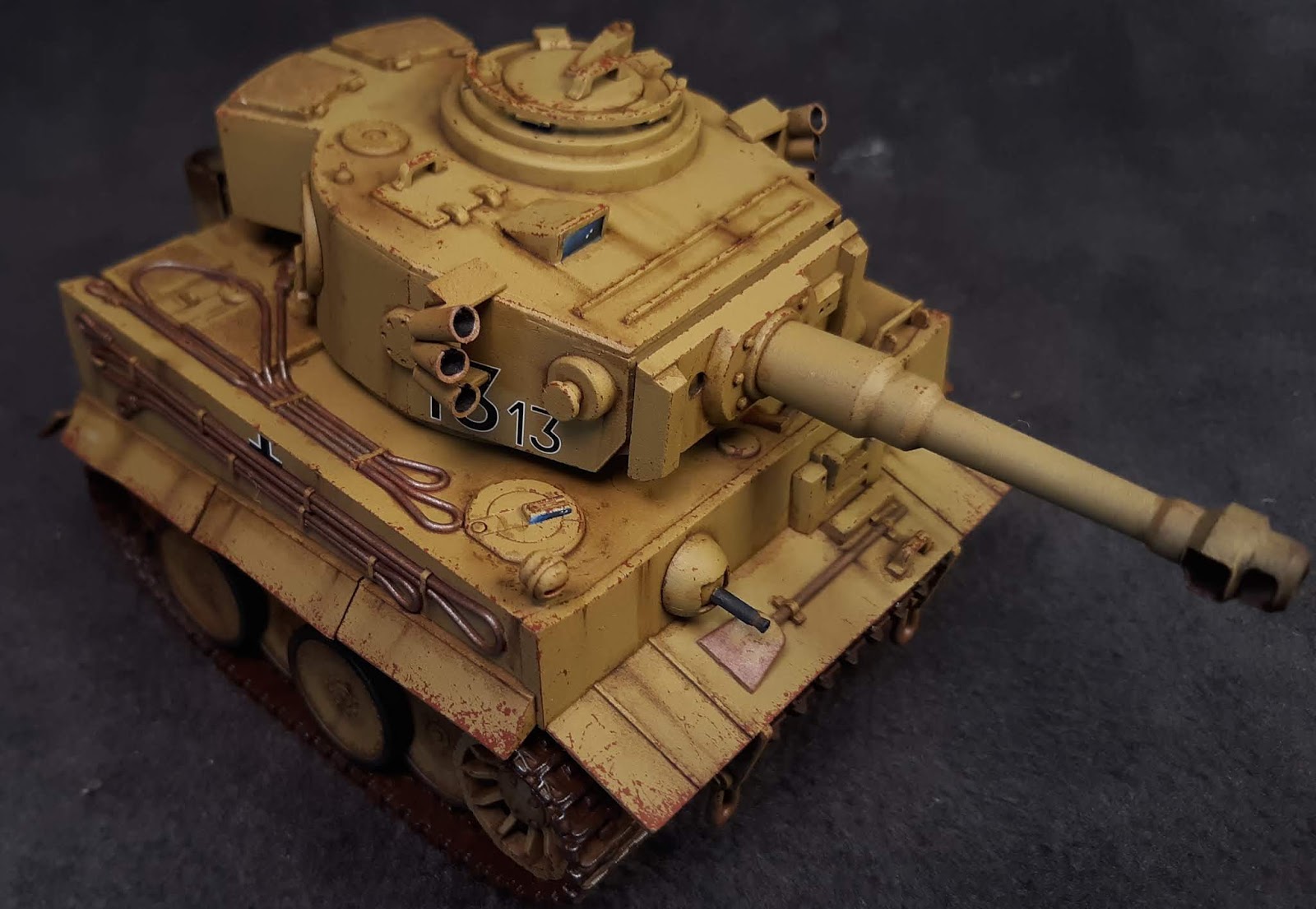
Way back in January I reviewed two of Meng's "World War Toon" Chibi tanks and I finally completed one of them. This was a fun kit to build and a nice change of pace from my usually serious work that simply sat half-complete on my workbench for most of this summer. If you want more info on the build itself, that is included with my review above.

To paint this model, I primed it using Krylon's Rust Red primer, applied a coat of hairspray, and then over-sprayed a basecoat mix of Tamiya 75% Dark Yellow/25% Yellow Green. Once dry, I applied some very light edge highlights using the mix above with a touch of pure white added and then began the chipping process. After chipping, I did detail painting as well as "jewel effects" on the periscopes/viewports using successive highlights of VMC Dark Blue, to VMC Light Turquoise, to pure white.

Unfortunately, the vinyl tracks were a completely new material for me to work with and I spent a lot of time researching what to use. In the end, I decided to go with multiple washes of diluted acrylic paints , mostly VMC German Grey, Tamiya Red Brown, and Testors Rust, and finally drybrushing with VMC Oily Steel (I love this color). As I wanted to make the tank somewhat realistic, I decided against using the kit decals and instead used decals from Topcolors 'Panzerwaffe 1941-43' book, based on a Leibstandarte Tiger at Kursk.

Once that was dry, I sealed the entire model and got down to some heavy weathering with oil washes and pigments. After that it was a simple matter of popping on the wheels and tracks and it was done. These are great model kits for their price and present a great opportunity for beginning modelers to learn how to assemble and paint a scale model without the worry of it being "wrong". 


Monday, June 10, 2019

Product Review: Pulp Alley version 2 Rulebook and Cards

While at Adepticon, I was finally able to play a large demo game of Pulp Alley after years of interest. Blown away by how much fun the system was, I went to order a copy and found out that the game designer, David Phipps, had a Kickstarter campaign for version 2. $50 and a few months later, I received my pledge - a PDF of the rulebook, an 8.5"x6" softcover rulebook, a small 6" ruler/rules reminder, two packs of Fortune cards, and a pack of Known Associates cards. 


You have to understand that this game is completely self-made by the creator, without any assistance from a larger game company, from (as far as I can tell) his own home. With that in mind, this game is as good (if not better) than many of the games put out by much larger game companies. The rulebook is well bound, in a nice handheld size with a glossy cover. The cards are all good quality, having the thickness of playing cards and a satin/semi-gloss finish. I would recommend putting these in some card protectors to extend their life and keep them looking brand new.


What is "Pulp"? Pulps were cheap, often lurid magazines popular in the early 20th century, usually before the widespread use of television, that entertained the masses with stories of brave explorers, cowboys, fighter pilots, and other heroes. Characters such as Tarzan, The Shadow, and Doc Savage were popular Pulp heroes and served as the template for other heroic characters that would be popularized in film long after the pulps had disappeared - Indiana Jones, The Rocketeer, Jack Burton. Pulp Alley focuses on these types of of heroic adventures however, the system is so open-ended that it could be used for a wide variety of miniature gaming from the Old West, early 20th century wars, and into Science Fiction.


Pulp Alley games are usually two or more players (though solo play is possible) who choose a warband or unit of between 3-6 characters (though larger size units, known as Mobs, are possible) who fight over control of themed objectives known as "Plot Points". Each character has a variety of stats and special abilities. Uniquely, Pulp Alley does not force your miniatures to be WYSIWYG (though it's still encouraged), as each character is defined by their statistics and abilities. Additionally, Pulp Alley uses a multiple dice system (from d6 to d12) to represent various levels of ability, difficulty, and damage with "successes" be consistently measured by rolling 4+ on any one dice.


In keeping with a cinematic feel, each turn, the initiative of play is dictated by "The Director" and this role can (and will!) switch between players every turn. The Director chooses which player may act and the chosen player activates one of their characters. Each activation the character can move and choose one action or attack. Once that character has completed its activation, The Director assigns play to the next player (or the same player), until all characters have activated.

And I hear the complaints now - "so I just have to sit around while other players act?". No, this is where the Fortune deck (and your hand of cards) comes into play. You may play Fortune cards to steal The Director's role, force other characters to activate, force characters to re-roll or re-do an action....if you can think of it, there is very likely a card that allows you to do it. This provides a feeling of suspense and dynamism as inactive players can change the fortunes of the active player and (in a group with more players) often will end up attempting to out-do each other with who can change the game quicker.


Character creation is very straightforward and user-friendly with a long list of special abilities, perks, and backgrounds. Want to have a debonaire secret agent with his secret agent buddies? You can do that. A world-traveling archeologist with a spunky female sidekick and his native guide? You can do that. Nefarious villain from the Far East with mystic henchmen? Lovecraftian cult leader with a gang of flunkies? Disguised aliens bent on world conquest? You can do all of it. Version 2 has also introduced an expanded weapons section, mounts and vehicles, as well as backgrounds and resources to give your warband a unique feel.


All in all, I've really enjoyed this game and have been surprised by just how easy it is to pick up and get hooked by. How this game doesn't have a much larger fan base is a mystery, as it would seem to attract the same crowd that have made other skirmish games like Frostgrave such massive hits. If you can, I would highly suggest picking up a copy and trying out a few games yourself.


Pros:
  • Engaging, fast-paced game suitable for nearly any genre
  • Well laid out, concise rulebook
  • Lots of gameplay examples
  • Despite overall book/card size, clear and legible font is easy to read
  • Good quality cardstock
  • Known associates cards are double-sided (edit!)
Cons:

  • Interior paper of rulebook is somewhat flimsy

Thursday, January 17, 2019

Product Review: Meng "World War Toons" Tigers


In an effort to do something a little different, I picked up two of Meng's new line of "World War Toons" tanks - the Tiger I and King Tiger. These super-deformed tanks are based on vehicles from the video game of the same name, and are part of a full line of popular WW2-era tanks. There's no scale listed but they range from nominally 1/35 to 1/48 scale and would work well for conversions for alternative history or science fiction gaming. Prices are extremely low, ranging between $9-$15, depending on the model. I believe I spent about $25 for both of the Tigers.


Plastic quality is very good considering the price, though there was a lot of mold release agent on the sprues when I opened the boxes but this was easily cured by a bath in warm dishsoap water. Sprues are organized well being generally divided by part type. Each model includes a great full-color instructions booklet, a few nice decals, rubberized tracks, and poly caps. The poly caps are useful in the Tiger I if you want free spinning wheels/tracks but, oddly, the King Tiger's roadwheels need to be snapped/glued in (even though the kit contains polycaps), preventing wheel spin.

Assembly is straightforward, though often requires a careful review of the pictures to ensure parts (especially tools) are placed in the right holes. There are some minor fit issues - mostly in the Tiger I - that requires some filling and sanding. Unfortunately, as all the stowage and tools have corresponding holes in hull, there isn't an option to not include them. Though this isn't technically a "snap fit" model, there are a lot of part that snap into place with little or no glue. In fact, in the pictures below, the hull of the King Tiger isn't joined because I want to be able to paint and weather the lower hull and, due to the snap pin assembly, it would be impossible to take apart once together.


Both models went together fairly quickly, being finished in a few sittings over the course of an evening. The Tiger I presented a bit more fit issues, especially the rear hull plate which had large gaps along either side of the hull itself. It wasn't a big deal, just annoying. All in all, these are great models for the price, very approachable for the younger or casual modeler and perfect for conversion fodder for gamers.

The Tiger I is a bit larger and taller than the King Tiger and would be very suitable for 40K in an Ork army.


Pros:
  • Very unique models
  • Easy to assemble, with lots of pseudo-"snap fit" parts - perfect for younger modelers
  • Great bases for conversion
  • Extremely cheap price point
Cons:
  • Some fit issues, especially in the Tiger I
  • Tools and stowage must be included
  • Not a lot of crisp details
  • Rubberized treads are difficult to paint and weather


Monday, January 7, 2019

Product Review: Rubicon Models 1/56 SdKfz 250 Neu


This isn't really a new release, but I haven't seen very many product reviews done for this kit and, after picking one up for my late war German army, decided to do one myself. My only prior experience with Rubicon was their extremely inaccurate and poorly modeled Panzer III kit (which I'm given to understand, they have since re-tooled) and their Opel Blitz (which is a decent kit) so I was a little hesitant but decided to take the leap...and I'm glad I did.


The kit itself consists of two sprues, an instruction sheet, and a German decal sheet. Having assembled a few Rubicon kits, it appears that their AFVs share the same decal sheet. On the plus side, this presents the ability to model all sorts of different vehicles and leaves a lot of extra decals leftover. However, this does prevent the modeling of unique vehicles, so take that as you will. The instruction sheet is clear and concise, as well as pointing out additional steps that need to be taken if you've bought one of the many expansion kits.

The plastic quality is decent enough, though even after washing I've noticed a slight glossy sheen to many of the parts. Whether this affect priming and painting remains to be seen (I'll update this if it does). The mold quality is fantastic - there are very little mold lines and flash or slippage is non-existent.


Assembly is fairly straightforward, though early on it requires several holes to be drilled to place parts and, in a few cases, it's unclear which hole needs to be drilled if you aren't using one of the expansions. My advice is to go slow and dry-fit parts before gluing. The only problem I ran into was that the slot to fit the side stowage bins isn't long enough, so they don't sit flush with the vehicle hull unless you remove some of the plastic on the back of the the bin to make it fit correctly. Three crew members are included - a driver, MG gunner, and commander - which is a nice addition and (unlike many kits in this scale) they are properly scaled and proportioned. I used the driver, but decided against the other crew...though I'll inevitably end up using them elsewhere. Another great option for this kit is the ability to easily split it into sub-assemblies for easier painting (seen below) that (as I dry fit them) seem to go together flawlessly once complete.


All in all, I'm very happy with this kit and highly recommend it!


Pros:

  • Extremely detailed and accurate kit
  • Pieces included to make the initial and later production models
  • Lots of optional kits available from Rubicon to make the different models
  • Extra crew included

Cons:

  • Being a very detailed kit, this may be complex for beginning modelers
  • Some very minor fit issues
  • No stowage included

Thursday, November 22, 2018

Product Review: Bolt Action Waffen-SS Squad (Winter)


A relatively new release to the Bolt Action line, the Waffen-SS Squad (Winter) is a welcome addition to players new and old. As the title suggests, these are Waffen-SS troops outfitted for cold weather fighting. As the war dragged on and Germany's logistical support structure was stretched to its limit, many regular German troops found themselves lacking essential supplies, among these were cold weather gear for both men and machines. Operating outside the normal military structure of Germany, the Waffen SS enjoyed a favored status among Nazi party officials and were often supplied with weapons and equipment not available to the Wehrmacht or other military branches. In addition to the revolutionary StG44 assault rifle, this unique gear included the SS parka - something not seen much in 28mm.

Now, here's where it gets a little confusing - the SS parka was issued three different times in three different versions. The first (issued in the winter of 42/43) had a fur-lined interior and a green-grey exterior. This version is known as the "Kharkov" pattern, since most of the troops fighting in the Third Battle of Kharkov wore it. The second (issued in the winter of 43/44) was reversible, having a white interior and a green-grey exterior. The third and final (issued in the autumn of 1944, just before the Ardennes Offensive) was also reversible, having a white interior and a camouflage exterior. As with most SS camouflage, these were (as far as I can tell) issued in every pattern, though logic would dictate autumnal patterns like the brown versions of Plane Tree and Oak Leaf would be most prevalent. The last two versions had interiors lined with Reizwolle, a recycled felt-like material made from wool, cotton, and rayon.


As you can see from the box art and the miniatures themselves, the wool-like texture of the parkas  is replicated. While I believe the sculptor's intent was to replicate the Reizwolle of the two later versions, at 28mm these could easily pass for the earlier fur-lined Kharkov pattern. By leaving out the StG44-armed figures and mixing them with some troops in greatcoats, this set could be used to bulk out Mid-War forces as well. While two of the figures have integral heads, Warlord's "Separate Head System" allows some uniqueness to the other 8, which have the choice of 10 different heads.

The squad includes the following:
  • NCO with StG44 assault rifles
  • 2-man MG42 LMG team
  • 1 man with StG44 assault rifle
  • 2 men with StG44 assault rifles & panzerfaust
  • 2 men with Kar98 rifles
  • 2 men with Kar98 rifles & panzerfausts
As of BA ver. 2, this squad would cost 190pts or 220pts, if the Fanatics option is taken. Personally, I think Fanatics is good, as not having to take a morale check upon losing 50% of the squad can be helpful, especially in games that requite objective holding in the late game. This squad could portray any force on the Eastern Front, in Hungary, and especially one during the Battle of the Bulge.

All in all, I really enjoyed this set. It's visually interesting and well-equipped and would make a great addition to any Late War German force. I hope Warlord finds this set profitable and expands this to encompass specialist weapons and gun crews.

Pros:
  • A unique set for Late War German forces
  • Well replicated Waffen SS parkas
  • Scaled perfectly with Warlord's other figures
  • 2 extra heads
Cons:

  • Some heads appear slightly underscale
  • Oddly, one crouching figure had mold slippage in between his legs, resulting in my having to file away large portions of detail but, due to its placement, really isn't noticeable

Friday, September 28, 2018

Product Review: Italeri/Bolt Action 1/56 scale StuG Ausf. G kit


I never had any intention of buying this kit but stumbled across an Ebay listing for almost 50% off and couldn't help myself. I should point out that I intend to complete this build as a Hungarian StuG, but all of my research indicates that - with the possible exception of swapping the German MG34 for a Hungarian Solothurn M31, stowage additions, and insignia - these StuGs were virtually identical to their German counterparts.

The kit contains two sprues of dark grey plastic, an instruction sheet, and a small sheet of decals. First impressions were relatively good - everything was well molded with very little flash or mold slippage, the instructions seemed clear and straightforward.

However, when I started assembly and dry-fitting, I realized something was off, as the hull is rather to short. The frontal armor seemed very thin and the rear engine deck did not have the noticeable "overhang" of the Panzer III/StuG series. Upon further research, I found that StuGs after the F model had either a 30mm thick frontal hull with a 50mm thick piece of armor riveted on or (post-1943) had an 80mm thick piece of armor that was welded fully unto the front of the hull. In either of these cases, this extends the front armor out substantially, but this kit had frontal armor that sat flush with the front of the track covers. It's my assumption that Italeri used the F-model as a basis for this part of their design and not the later G model.


Is something like that a big deal? Probably not to most gamers. Unfortunately, there are a few other issues. Italeri molded on what appear to be rivets on the hull frontal armor, the crew compartment frontal armor, and the gun mantlet itself. These should actually be hex nuts on the mantlet and hew nuts with protruding bolts on the frontal armor.....so I re-did the frontal hull armor, scraped off the rivets, and replaced them with plasticard hex and circle rod.

Okay, done right? Oh no, wait, there's more. The driver's visor is too small and there's a massive (and I mean, massive) armor block on the hull in front of it. So I was forced to very carefully slice the armor block to a manageable (and realistic) size and replace the visor.


With that done, I had to address the lack of the overhanging rear engine deck. This is a common feature to the Panzer III chassis, so it's really odd that Italeri decided to make their engine deck/rear armor plate flush with one another. I accomplished this by adding a piece of .020 plasticard to the last "angle" of the engine deck (disregard the stowage rack) and then sanding it flush with the rest of the engine deck. It's not complicated, just annoying to have to do.


At the point however, is something that I can't abide - incorrect instructions. At Step 5, the commander's periscope (Part #26) is mixed up with the Notek blackout light (Part #2) in the instructions. A beginning or unaware modeler could easily miss Italeri's mistake.

Otherwise, the rest of this build was fairly straightforward. The schurzen are a very tough assembly but they do look good. I actually haven't glued them on for these pictures; they can be held in (if you're delicate) just by tension alone. A minor quibble is that the gunner's hatch (when assembled in the closed position) is just a flat piece of plastic with no hinges. As with every Italeri kit, the crew figure included is both badly sculpted and badly molded, which I've come to expect.


Decals provided are fairly basic, which is in keeping with most of the real-life StuGs, including a variety of black and red numbers and two pairs of unit insignia. The painting guide includes directions for three separate finishes, all from 1944 - two from the Italian front and one from Normandy. Given my earlier critique of the incorrect frontal armor, I find these choices even more baffling, as after 1943, most StuGs were upgraded to the much thicker, welded frontal armor.

Overall, especially for the beginning modeler, this is a fairly solid build if you're not too worried about authenticity. For the skilled modeler and rivet counter, I would not recommend it unless - like me - you bought it at a very steep discount. I would highly recommend buying separate crew models (available from Warlord and Perry), as the base model is well suited for including them, but the stock crew is very poorly sculpted.

Pros:
  • Easy customizations allows for model variability, regardless of skill level
  • Nice base kit for conversions
  • Easy and quick assembly, especially for beginners
Cons:
  • Incorrect part placement in instructions
  • Incorrect frontal armor arrangement
  • Open gap behind the gun mantlet
  • Badly proportioned and scaled crew figure

Sunday, November 12, 2017

Necromunda: Underhive and Gang War Initial Thoughts

I had a chance today to sit down with both the copies of the new Necromunda Underhive boxed game and the Gang War expansion book and wanted to give my initial thoughts on both. As such, this shouldn't be taken as a true review, nor as a simple unboxing, but more as an attempt to provide my own feedback with my own background.

For those of you who are unfamiliar, I have a long and varied history with Necromunda. Way back in 1995, when I was 16, Necromunda was the very first miniatures game I had ever bought. I played it nearly every other day that year and pulled it out often during high school. When my now-wife and I moved to Chicago in the early 2000s, there were essentially no gaming stores in business within city limits in which to play, so I formed a small group of players. By 2008, I had been introduced to the Adepticon gaming convention and volunteered to run a Necromunda tournament that became an annual tradition and was, as far as I know, the only competitive Necromunda event in the world (at least during that time). Shortly thereafter, I sat down and wrote the expanded ruleset known as Inquisimunda - an expansion still played, even after my involvement in the project waned and I had stepped away; version 2 being due to the efforts of many wonderful volunteers. With the new release and my prior experience, I've been tapped to lead the Necromunda team at Adepticon. So, you can say I'm fairly knowledgeable on the subject....

Underhive Boxed Game


With that said, these are my initial impressions done by taking about an hour to flip through the book and recall previous versions, so there may be some minor errors. Measurements are approximate since I didn't have a ruler. The boxed game itself is simply jammed pack with lots of GW goodness. The templates are of similar size as those used previously - a flamer template, 3" blast and 5" blast. Terrain includes 10 2"x2" barricades, ~5 Loot Caskets, a "Beast Lair" marker, Priority marker, 4 computer terminals, and a small Imperial shrine (which, intriguingly, has no rules....perhaps a Redemptionist objective in the future???). Terrain also includes 5 large 4"x2" doors and 2 1.5"x2" small doors that are only used in the "board" style game.

The miniatures themselves are definitely larger than the old ones but probably not "true" 32mm. The most noticeable difference would be in the Eschers; Goliaths could easily mix old and new miniatures. There is a lot of interchangeability with heads and hair, but probably not quite as much with arms. Interestingly enough, each gang has a different base size (Eschers 25mm, Goliaths 32mm), which means that Goliaths will have a wider area of effect but will also likely suffer more from templates and Broken results. The Escher models in the box tend to favor las and autogun weaponry, while the Goliaths tend to favor stub and shotgun weaponry.

There are 10 named Goliath cards, 10 named Escher cards, and ~20 blank generic fighter cards. I am unaware of any plastic sleeves on the market that would adequately fit their larger size, but it will only be a matter of time before someone releases them (or they could be laminated). The named Goliaths tend to be slower but stronger and with heavier armor; whereas the named Escher tend to be faster and more nimble but with weaker armor. Terrain tiles are about 12" square with 1.5" squares to denote tunnels and passageways.

One of the new features are the addition of "Tactics" cards which are similar to those used in 8th ed. 40K. Each gang has 4 unique Tactics cards and there are 20 generic Tactics cards. Goliath Tactics are shrug off injuries, increase charge distance, increase Strength and Toughness, and stand up Pinned models. Escher Tactics are counter a charge, force an opponent to Nerve test before battle, set a gas trap, or move their models before battle. Generic Tactics include (but are not limited to) extra armor, bobby traps, hidden passages, and multiple activations.

The main rulebook is fairly nice. If I have one criticism of it, I'd say the old rulebooks have much more artwork and more in-game pictures, which tended to add inspiration for new players to get their miniatures and terrain assembled and painted. The first ~35 pages of the book are devoted solely to fluff and immersing the player into the world of Necromunda. If you are familiar with the old rules, there really isn't much new info here.

Fighter characteristics and loadouts are fairly similar to previous editions, with some new characteristics (Cool, Willpower, and Intelligence). Each turn players roll for Priority and place their Readied markers and are then able to activate each fighter and that fighter gets ~2 actions. Actions include basic move, basic shoot, aiming (+1 to hit), charging (+D3" to Move - HUGE change from previous editions!), take cover (move up to 1/2 move then go to Pinned), Coup De Grace (basically eliminate an injured fighter not engaged in HtH combat that's within 1"; this is a free action if injured in HtH combat as with previous editions), reloading (basically roll to make a weapon usable after a failed Ammo roll), open or close a door, use a terminal, break down a door, crawl/fire through a duct, and open/lockpick/carry a Loot Casket.

Fighters in HtH combat have two basic actions - fight or retreat. Pinned fighters may stand (recover from Pinning), crawl (1/2 move), blind fire (shooting attack, -2 to hit), and reload. Injured fighters may only crawl.

Shooting and HtH mechanics are similar to previous editions, with the addition of a "prone" stance to shooting that confers a -1 to hit modifier at long range. There is a 90 degree vision arc, so models in competitive environments will absolutely need to have a tick mark on their bases to denote facing. Fighters may fire two pistol weapons at the same target with one action with a -1 to hit modifier. The Stray Shot rules do remain. And yes, Overwatch is "gone", having been changed to a skill (more on skills in the Gang War section). Multiple HtH combats are handled as each fighter either adding or subtracting 1 to the fight result.

To wound, gone are the calculation tables comparing Strength and Toughness on X and Y axis. Instead, it is a simple chart - twice the Strength to Toughness? 2+. Strength Greater than Toughness? 3+, etc. Injury results are the same, with the term "Seriously Injured" replacing Down. Nerve Tests for fighters are taken if a friendly model goes OOA or is Seriously Injured within 3" - test using the Cool characteristic, adding 1 for each other friendly fighter nearby. If failed, the fighter runs away to cover and is Broken. Broken fighters continue to run if there are enemies in LOS, are never Readied, may Rally in the End phase, and while Broken only react to HtH combat attacks.

Unto basic terrain rules - Doors block LOS and movement (when closed), have T 5 and 4 Wounds. Barricades provide -1 to hit modifier in Shooting and HtH combat. The "Beast Lair" marker is very cool - if a fighter ends their activation within 6" there is a chance they're attacked with a VERY tough attack (I won't ruin how brutal it is here! Mwahahaha...) and has T4, 3 Wounds, and is -2 to hit! Ducts act as walls and pitfalls require Initiative checks if a character is pushed into them or they go Out of Action. Toxic Sludge pools make fighters -1T if they stand within them and can cause them to go Out of Action is they are knocked down into them. Loot Caskets have the possibility to be a trap, nothing at all, or ammo.

Gang War


Hmmmm....it's tough to say how I feel about this expansion. They've done a nice job of streamlining some of the more "advanced" rules here, but there are also some really glaring omissions. The main "board" game style is referred to as Zone Mortalis and seems to line up with (admittedly what little I know of) Zone Mortalis itself. The "3D" or "Classic" style is referred to here as Sector Mechanicus. I'm not sure how much traction the community at large will give these easily trademarked names but....time will tell.

As for the 3D rules themselves, there really isn't a whole lot here, with the rules only taking up about 8 pages. Terrain is either an obstacle (anything smaller than 2"x2"x2") or a Structure. True LOS is covered, terrain is catalogued as either normal (full move) or difficult (1/2 move) terrain, platforms and overhangs are covered as well (basically, if a figure can fit, they can move there). Climbing without the aid of a ladder is done at 1/2 movement; climbing with a ladder is done at full movement and the time-honored tradition of "running" up a ladder is omitted (that's definitely going to be house ruled by veterans). Jumping, leaping, and falling are treated in similar ways to previous editions. Doors are omitted here (unless of course, like me, your terrain has doors, in which case you're free to use the Door rules). And.....that's about it.

Next are the campaign rules. The biggest change here is to the Experience and advancement rules. Experience is given (for now) only by taking another fighter Out of Action, which earns +1XP. Everyone but basic Gangers are given the chance to "purchase" advancements at a set rate. Every subsequent time that advancement is purchased, it's cost increases by +2XP. Basic Gangers must "pool" their first 6XP, at which point they roll 2D6 and take a one-time advancement (unless they are promoted to Specialist by rolling a 2 or 12). I'm unsure how I feel about this - while it certainly speeds up the post-game sequence, it feels too much like Mordheim, in which your basic fighters were pretty much meat shields for the Heroes. Only lists for House Escher and House Goliath are included in this supplement (these lists replace those in the boxed game rulebook).

With that said, GW have also left out an "Underdog" Table. For those of you who don't know, this table was the difference in points between each players gang rating that would add additional experience to the "weaker" gang in the post-game sequence depending on how much of a difference there was. This helped to balance out play between older and newer gangs and gave players entering campaigns at later points a slight boost to keep them competitive. EDIT: There IS a function similar to the table in the pre-game (in which the "weaker" gang gets an extra Tactics card) sequence, but I don't feel this is as good of a balancing function, in and of itself.

The injury list is similar, including the much-hated Death result and Captured result. The territory list is similar (if not exactly the same), as are the Skill tables and much of the Trading Post. Included at the very end of the book are six Scenarios, of which I think Border Dispute is probably the only truly "new" scenario.

The biggest omission here, and I think my main issue with this book, is the lack of Hired Guns. Hired Guns were probably the best thing about previous editions, as they added a bit of flavor and the ability to balance out a gang that may be lacking in an area of expertise. Hired Guns like the Scum, Ratskin Scout, Pit Slave, and Wyrd are absolutely iconic miniatures from GW's 1990s lineup and their absence is glaring here. In their absence, I think GW should have included something extra to balance it out, perhaps something like some exclusive Tactics Cards. EDIT: Forgeworld is releasing a named Imperial Beastman Hired Gun and has plans to release more. However, I feel this is a bad idea for two reasons. First, while named characters are fun (Mad Donna Ulanti, anyone?), the big appeal of generic Hired Guns was the nearly limitless modeling potential, giving these products a broader appeal among the community. Second, with rules being included with the miniature, this lowers the visibility of these to potential customers but most importantly, to an event organizer like myself. TOs and Judges shouldn't have to buy multiple miniatures to understand how they work in-game and to decide whether or not to include them in an event. GW would be best served by releasing a compilation of Hired Guns, named characters, and creatures in a single book format, much like Outlanders.


In conclusion, this is an almost perfect re-release of a beloved miniatures game and I really hope that GW is willing to listen to feedback from the community and expand upon this initial release to bring it more in line with the vast array of gangs, miniatures, and fluff from previous editions.


Thursday, July 20, 2017

Movie (Mini-) Review: Dunkirk

I was lucky enough to just get out of an advance screening for Dunkirk just a few minutes ago and thought I'd write up a short review of the movie for those of you who are interested in the period, but are unsure about spending the money to see it in theaters. I will point out that I do like most of Christopher Nolan's work, so if you aren't, you should likely take this review with a grain of salt.


The movie revolves around the experiences of six "main" characters during the evacuation of the British Expeditionary Force from the port of Dunkirk, France. A very unique aspect of the narrative is that it is told in three distinct parts - 1. The Mole - One Week (referring to the eastern sea wall Capt. William Tennant used as a makeshift pier), 2. The Sea - One Day, & 3. The Air - One Hour. At first, it's very confusing about what exactly is going on as events in each "part" don't always occur linearly. While it eventually becomes apparent how each "part" is laid out sequentially, the key is referring to the subtitle of each "part". The characters' experiences in The Mole take one week, in The Sea one day, and in The Sky one hour. I really enjoyed this aspect of the narrative, since it wasn't something I'd seen used successfully since Pulp Fiction.

Without giving away too many spoilers, the plot seems to be very factual and, for the most part, does follow the overall historical event quite closely. Obviously, this being modern cinema, there are some fabrications and anachronisms, but nothing that takes you out of the movie. The one criticism I would have is that the defense of the Dunkirk perimeter isn't really shown and the danger of being truly surrounded is only hinted at. I feel like if Nolan were to have focused on this more in the prologue, that casual viewers would really get a better sense of how dire the situation truly was. Nolan does, however, do an amazing job of ramping up the tension - not too fast, not too slow.

The visuals are absolutely stunning. In a year where CGI-laden, post-processed movies are the norm, it was fantastic to see a movie that (to my eye) relied on no CG special effects. The aerial dogfights in particular are the star of the show and, if you're a plane buff, I urge you to go see the movie in cinema format - the planes are gorgeous, especially against the backdrop of grey skies and green-blue ocean. Nolan also captures the opposing dread of being caught wide open on a beach or stuck inside the hold of a sinking ship.

The acting is top notch....with my one big criticism of the movie being that the dialogue was often unintelligible. I wasn't sure if that was an audio issue or intentional on part of the crew (or as part of the narrative). Casual viewers are going to have a very difficult time understanding what orders are being given as, even with a good idea of military orders, even I had a tough time trying to decipher what was actually said. Tom Hardy plays Spitfire pilot Farrier...but he's really just channeling a WW2 version of Mad Max (which, having loved Fury Road, I was totally OK with). Mark Rylance as small boat captain Mr. Dawson is probably the stand-out actor as he does an amazing job acting a wide variety of emotions, often non-verbally (if you like him in this and like historical dramas, I also recommend checking out his role as Thomas Cromwell in Wolf Hall. While I didn't love the series - period dramas about British royalty are more my wife's passion - I did like his portrayal.

The sound (except for the dialogue) was also fairly good. The Stukas, while having their tell-tale diving drone, also have an odd, slightly unnerving shriek as they level off. Gunshots and explosions are deafening, and are well contrasted by the quiet beaches (early on) and the crashing waves (later).

All in all, I'd say - unless you truly hate Nolan's work - go see it in theaters. It's worth it and, if it grosses highly enough, will hopefully prompt the studios to do more of these types of historical action dramas.

Tuesday, May 16, 2017

Product Review: Shadow War Armageddon (From A Necromunda Perspective)


Well, I hate to say it but I recently broke down and bought my first Games Workshop product in almost 10 years...and from a GW store on top of it! That product was the rulebook for Shadow War: Armageddon, Games Workshop's possible reentry into the skirmish gaming market. This review will consistent of my initial impressions of the book itself without having played any actual games. I will likely do a second review that takes a more in-depth look at the ruleset and how it actually plays on the tabletop.

First, though, let me take a small aside...

When I was a teenager way back in the early 1990s, there was a small game store in the local mall that carried a good selection of miniature games, especially GW. I had been exposed to RPGs in the 1980s but walking into that store and seeing the miniatures...something clicked. A few months later and I was working at that same store (for those of you in the Chicagoland area, that store was Gamers Paradise - both loved and reviled by many) and with my first check I bought my first miniature game - Necromunda. I played that game for ages and kept the box and components until they literally started falling apart. Lots of games came and went but Necromunda was always somewhere in the rotation. Unfortunately, the mentality at GW changed and Necromunda was given a (largely disliked) second version and, when the mentality of GW further changed, the game was abandoned entirely. Undaunted, I still played, eventually going on to run it in a tournament format at Adepticon and then expanding upon the ruleset with my own Inquisimunda rules.

I relate that story because - in full disclosure - I am probably not the most impartial judge when it comes to reviewing this ruleset. I would, however like to think that I have enough experience with the initial ruleset to adequately relate what works and what doesn't in SWA. Which leads to the biggest asset - and problem - with Shadow War. It is, at its core, a repackaged and slightly streamlined version of the original Necromunda ruleset from 1995.

In Shadow War (Necromunda), players control warbands (gangs) consisting of xenos, mutant, and human fighters (gangers) in the nightmare universe of Warhammer 40K. Warbands (gangs) consist of individual fighters (gangers) who engage in a series of linked games that form a campaign, acquiring experience, injuries, and Promethium (territories). So, while the game consists of individual scenarios, one of its big attractions was this semi-RPG element of treating in individual miniatures somewhat like player characters.

The book itself is nice. For $40, you get a 200 page softcover book consisting of background, the core ruleset, the original warband lists released with the boxed set, all the warband lists released as free PDFs, as well as two new warband lists only available with this ruleset - the Sisters of Battle and Inquisition. I personally would have preferred a hardcover in the style of the Necromunda/Outlanders big book from 1998 (because its held up very well over 20 years, whereas my softcovers have not), but this is a minor complaint.

Components necessary for SWA are almost exactly the same as Necromunda, with the exception of the small (2") blast template and the hand flamer/webber template. SWA retains the Flamer template, 3" & 5" blast templates, D6 base dice (as well as its - at the time - odd proxy 'D3' mechanic), Scatter dice, and Misfire/'Artillery' Dice (hope you saved all those from years ago!).

The other major component is the player's warband...and its here where we come to the largest departure from the Necromunda ruleset. Gone are the gangers, beasts, and hired guns in favor of warbands that more closely mimic units available to armies in the larger army-based game of 40K. To be fair, it is still possible to run your old Necromunda gangers using the Astra Militarum or Genestealer Cult rules (or even as Cultists in a Chaos Space Marine warband), but you will run into issues with Special Operative models. Warband composition is similar to Necromunda - you choose a Leader, at least 50% Basic Troops, New Recruits, and 2-3 Gunners (similar to Heavies) and this basic warband list is backed up by Special Operatives, which can be recruited using the warband's Promethium Stores, to help in each scenario (somewhat similar to Hired Guns). Additionally, each warband has one or more special abilities and (often) access to warband-specific weapons and equipment (similar to the Version 2.0 Necro lists). Warband composition is as follows:

Space Marines - selected and modeled from Scouts. Special Operatives include Apothecaries, Vets, Terminators, and Deathwatch (are fairly balanced list with good selection)

Orks - Nob leaders and Boyz troopers (Gorkamorka players will appreciate Recruits being "Yoofs"). Special Operatives include Meks, Doks, Flash Gitz, and (rather oddly) Runtherd & Grots (the lack of MegaNobz to compete against the abundance of other lists' heavy armor is a bit concern here)

Astra Militarum (IG) - standard human troops. Special Operatives include Commissars, Enginseer, Ogryn, and Scions. (seems fairly balanced but an Inquisitor or Space Marine should have been an Operative)

Sisters of Battle - exactly what you think. Special Operatives include Repentia, Celestial, and Seraphim (nice list; Light of the Emperor ability could be absolutely brutal in a shooting-centric game like this)

Chaos Space Marines - Leaders, Troops, and Gunners are CSM; Recruits are Cultists. Special Operatives include Raptors, Terminators, and Spawn (an expensive and limited list probably not recommended for players new to skirmish level games but provides some nice modeling and fluff potential)

Dark Eldar - Wyches, nothing but Wyches. Special Operatives include Succubus, Haemonculus, and Scourges (a Hand-to-Hand list that gets over some of the issues of HtH lists in Necromunda by providing fighters with a 6" basic Move and high Initiative)

Craftworld Eldar - Dire Avenger Leaders and Troopers with Guardian Recruits and Gunners. Special Operatives include Autarch, Wraithblade, and Wraithguard (this seems like the weakest list with some very odd choices in the Dire Avengers and no aspect warrior Operatives. Rangers absolutely should have been in the basic list)

Genestealer Cult - Neophytes abound. Special Operatives include Hybrids, Metamorphs, and Genestealers themselves (probably the most "fun" list with lots of options for equipment and weapons and lots of modeling and fluff potential. This list seems much more at home here rather than at the army level in 40K)

Grey Knights - exactly what you think. Special Operatives include Purifiers, Interceptor, Paladin, and Terminator (as with CSM, an expensive and limited list probably not recommended for players new to skirmish level games but provides some nice modeling and fluff potential)

Harlequin Troupe - exactly what you think. Special Operatives include Death Jester, Solitaire, and Shadowseer (another HtH list with the same HtH advantages of Dark Eldar with a higher cost but an ability that makes them harder to shoot at. Expensive but this list could absolutely dominate the right tables)

Inquisition - an Inquisitor, their Acolytes, and with their "Gunners" being HtH Crusaders. Special Operatives include Arcoflagellants, Death Cultists, and Deathwatch (a nicely balanced list with some huge potential for modeling and fluff)

Necrons - Immortals, Warriors, and the Deathmark. Special Operatives include Lychguard and Praetorian (somewhat expensive and mainly focused on shooting but their ability makes them very tough and will require opponents to come up with a good strategy to force Bottle Tests)

Skiitari - exactly what you think. Special Operatives include Enginseer, Ruststalkers, and Infiltrator (a list that heavily favors shooting but the points are right and some of their weapons could be absolutely devastating)

Tau Pathfinders - Tau and Drones. Special Operatives include Stealth Shas'ui, Fireblade, and Ethereal (another lists heavily favoring shooting with a large basic selection, not anything fascinating here though)

Tyranids - Nid's and Gun Beasts. Special Operatives include Ravener, Zoanthrope, and 'Nid Primes. (an expensive list with a mix of HtH and shooting, lots of abilities. I do find it odd that neither a Nid Leader or Troops cause Fear)

As far as the rules themselves are concerned, they are almost verbatim taken from the original Necromunda book with some minor tweaks. For example, Shooting works the same as the original rules, with the inclusion of the High Impact and Stray Shot rules from Version 2.0. High Impact was necessary to add due to more heavily armored fighters in this game, but Stray Shots seems like an odd choice which, I can only imagine, was included to prevent bunching of HtH-centric warbands. Flipping through the Hand-to-Hand and Leaderships sections of the rulebook alongside my hardback Necromunda copy the rules and layout are almost exactly alike. Those of you who are veteran players of Necromunda know all the in-and-outs and the subtle cheats to these rules so, while it is nice to see the good things about the ruleset reproduced, it does strike me as odd that practically nothing was either tweaked nor added to make it at least slightly different. The only new tweak, not inherent to either Necromunda edition, appears to be the rules for Falling...but than only slightly.

The scenario list is again almost verbatim taken from the original Necromunda book...and, unlike the other sections, I can't seem to find any tweaks. This isn't a big deal because the original scenarios were just so great but, again, it's odd that GW didn't even bother to add at least one new scenario, especially considering the host of scenarios that were produced in Outlanders and the Necromunda magazines. The campaign system is (somewhat disappointingly) the biggest change. Gone are the extensive injury chart, the trading post, the Territory list and income generation. Instead of territories and income, warbands generate a preset amount of Promethium caches which are used to pay for the services of Special Operatives in subsequent games on a one-to-one basis. To me, these were the most fun aspect of the original Necromunda rules because they added to the fluff and modeling aspect of the game. Without them, while the post-game sequence is more streamlined, it feels rather lifeless and generic. Luckily though, the Skill tables are still there with some minor improvements, which is a plus. With the rules being so similar, it's definitely easy to simply use those old scenarios if you still have access to them.

So, without any games under my belt, that's the long and short of Shadow War Armageddon. The verdict? It's nice - not terrible, not great. It's a good beer and pretzels game that will get some of us old 40K players to crack out our models, as well as providing a somewhat cheap springboard for newbies to get into 40K. It may also function to get more players interested in more intense, narrative-driven campaigns that can be accomplished with Inquisimunda supplements. With the developments within GW itself, I remain cautiously optimistic that SWA will be supported and perhaps widened in scope and playability.


Pros
  • Great to see an skirmish-sized game for 40K
  • Great "Beer and Pretzels" game
  • (Most) everything you loved about the original Necromunda rules
  • Smaller units allows play for newbies, seasoned players, and returning veterans

Cons

  • Almost a page-for-page reprint of the original Necromunda rules
  • Everything you hated about the original Necromunda rules
  • Lack of real, campaign depth
  • Some warbands are very bland with odd Specialist choices

Thursday, May 11, 2017

Product Review: Oregon Trail Card Game


A few months ago, I bought my wife the Oregon Trail card game from Pressman, available through Target. She's a huge history buff and absolutely adored the computer game when she was a kid so I figured "what the heck?". I held off on reviewing it for several months because I really wanted to see how it played after multiple sittings, especially family game nights. And, after several months of playing it, I think I can reasonably conclude....

This is a game for masochists.

So, if you aren't of a certain age (born in the late 70s or early 80s), you probably won't know about the background of Oregon Trail. Way back in the day, before the current golden age of computer and console games, developers were still trying to find markets for the fledgling video game industry and one of those markets was education. The 1980s saw several now-classic educational games marketed towards children, among which was a game called The Oregon Trail. In the Oregon Trail, the child took on the role of early American pioneers journeying down the Oregon Trail to present-day Oregon.


The player would choose how to outfit and equip their party, what routes to take, when to hunt, and (most memorably) whether to ford or float across rivers. It was a game that had a learning curve and required a certain amount of skill and strategy to survive the wilds of the 1800s American West. As children, my wife and I fondly recall spending hours trying to win by reaching the fabled ending in Oregon. I can't be sure whether I ever actually beat the game (I was much more fond of Nintendo at the time), but I do recall it being difficult but fair.


And, I'd have to say this is where the card game goes awry. It's not fair. There is little to no strategy. I get the feeling that Pressman was banking on the nostalgia factor to make the game successful, rather than taking an existing franchise and building a good game from that foundation.

Play proceeds as such - each player has a certain number of Supply and Trail cards. Trail cards are laid out one at a time to build up "decks" of 5 trail cards each. A total of 10 decks of trail cards are required to reach the Willamette Valley in Oregon. Yes, you read that right, it takes 50 Trail cards to finish the game. Supply cards provide supplies to survive as reactions to Calamity cards - clothing, extra oxen, clean water, etc.

There's a couple of issues here right off the bat, before play even begins. First, depending on the number of players, there's a maximum of ~15 Supply cards TOTAL, meaning the group can only "survive" about 15 Calamity cards....if they aren't forced to discard their Supply cards. This leads to the second issue - the overwhelming majority of Trail cards force the player to either roll to cross a river (and if you fail you lose a Supply card) or automatically force the player to draw a Calamity card. Cards that do not have any effect are few and far between.

To be fair, there is a way to replenish lost Supply cards via Towns and Forts. However, there are a total of 4 of these cards, allowing players to take a total of 6 Supply cards (if they happen to lay down all 4 of these cards before dying). I'm not great at math, but I know that means you're either going to run out of Supplies long before you win or you have to have some damn good luck. Now, all these factors alone could still make for a challenging, but achievable, game. The problem comes in the fact that there are some Calamity cards that, once drawn, mean certain death for the player. No saves, no rolls, no using Supplies to avoid them. Death. You're out. This means that there's no good strategy - you can still plan and work your hardest, put one wrong draw and you die.

So after several months and several plays, none of us has won. And I would question the honesty of anyone who plays this card game and claims they did win. It's just not possible...and that makes for an unenjoyable game (unless you're a masochist). Don't get me wrong - I like challenging and difficult games. I don't mind wading through insane hardships to finally achieve victory. But I, the player, need to have some mechanism or strategy to be able to achieve victory and the problem with Pressman's Oregon Trail game is there isn't one. That makes replay value low. It's fun to play once or twice for the nostalgia factor...but it's clear Pressman didn't care if the customer actually was able to win.

While I would like to recommend this, I have to say if you want to play The Oregon Trail, find an emulator and play it on the computer.

Pros:
-Relatively inexpensive
-Easy to learn
-Some nice "old school" 8-bit graphic art

Cons
-Insanely hard to win
-Auto-death Calamity cards feel cheap
-Difficulty and lack of strategy prevent replayability


Monday, November 14, 2016

Product Review: Trenchworx WW1 Mk.IV Tank

I bought this kit for my planned German Revolution project as Freikorps armored support with a gift certificate from Operation Sting provided by Trenchworx. The model was shipped very quickly (about 3 days) and also arrived quickly (another 3 days). As with all Trenchworx products, the model comes packaged in its own box, wrapped very well in bubblewrap with clear, detailed instructions. 

First impressions were pretty good. For a resin kit, it's fantastic to have some clear instructions, making this kit very approachable for new modelers. The resin looks and feels nicely cast, with little to no noticeable mold release. The components consist of a main body, two track assemblies, two Male sponsons, two Female sponsons, and the various detail parts.


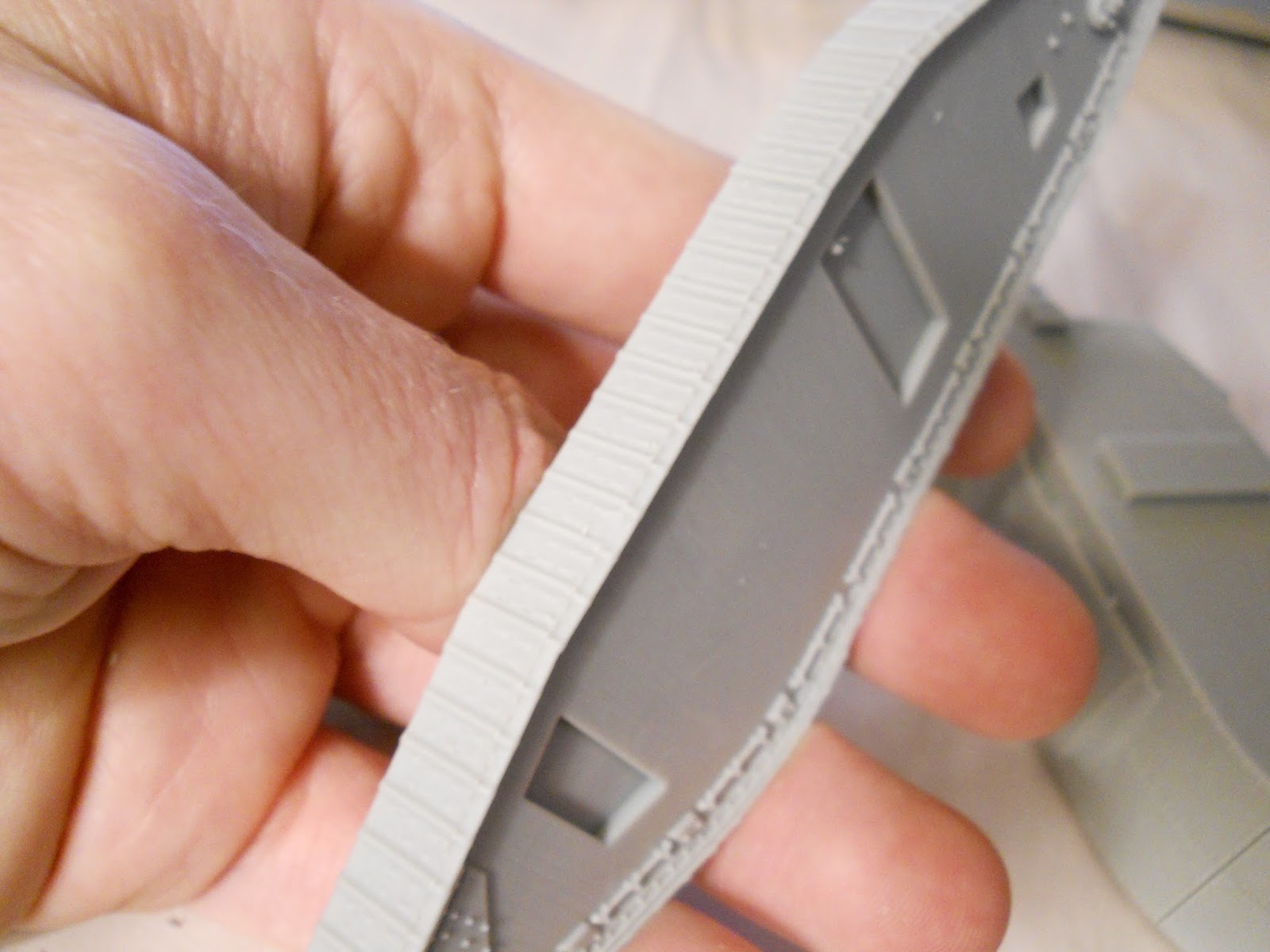
Assembly was fairly straightforward however, there are VERY prominent mold lines running along the inner edge of each track assembly. In the picture below, you can see the mold line. This is, by far, my biggest issue with this model because, to fix it, requires cutting and sanding each individual track section to be level. This eliminates the fine riveting detail on each track section and takes forever to complete.


The biggest redeeming feature of this model are the magnetized, interchangeable side sponsons. This enables the modeler to quickly and easily switch the tank to either Male (cannon-armed), Female (MG-armed), or Hermaphrodite (one cannon, one MG). It should be noted that the Hermaphrodite version of the Mk. IV is highly contentious among scale modelers, as no visual evidence to their existence is known.


Another issue with this kit is the tiny muffler exhaust pipe. Despite being the smallest piece of the kit, it isn't attached to any sprue and I, inevitably, lost it. It would also have been nice to receive a pair of dorsal rails for the main body. These were fitted to many Mk. IVs to carry logs or fascines as anti-ditching devices.


In the end, the completed kit is nice and the scale seems correct (total dimensions are ~6"L x 2"W x 1.75"H). However, without the certificate, I wouldn't have been happy to pay $40 for this kit. Let's be honest - for a 1:56 scale kit, $40 is extremely overpriced, especially considering that many 1:35 scale Mk. IVs are the same price.

Pros:

  • Interchangeable, magnetized sponsons to change to Male, Female, & Hermaphrodite versions
  • Poseable MG and cannon
  • Overall nice detailing and scale

Cons:
  • Very prominent mold lines on tracks
  • Exhaust pipe has no sprue and is easily lost
  • Lack of dorsal rails
  • VERY expensive

Wednesday, October 12, 2016

Product Review: 4Ground's Shotgun Shack (C)

"And you may find yourself, living in a shotgun shack...and you may ask yourself - well how did I get here?.."

The opening verse of Talking Head's "Once in a Lifetime" seems appropriate enough to open with, as I'm not really sure why I bought this building, since it doesn't really fit well with any period I currently play. But it was nearly half the retail price on Ebay, and being curious about it since its release a few months back, I snatched one up.

Like all of 4ground's kits, it's quite nicely packaged in its own cardboard box, with the sprues being packed again in plastic inside. There are 7 sprues altogether - 4 unpainted MDF "interior" sprues, 2 painted MDF exterior sprues (painted in a very light yellowish-tan color), and 1 painted MDF roof sprue (painted in black with a satiny finish to mimic tar paper).

The instructions are pretty well detailed, though they are lacking in particulars. Building the interior is simple and straightforward, but it becomes increasingly necessary to dry-fit many of the pieces after this. The foundation in particular would be easy to screw up, since the front and back porch holes need to be positioned accurately below each door. Position them wrong and the back porch could end up mounted under the back window.

As mentioned earlier, the interior is built first and is the easiest portion of the build. Following most other 4ground buildings, the interior is assembled as a box and the exterior walls and foundation are glued around the outside of this box. If you're new to this two-step build process, do yourself a favor and grab clothes pins or clamps beforehand to hold pieces in place as the glue dries. After the interior, the foundation is assembled, then the exterior sides are glued on, and then the porches are assembled and glued on. The porch stairs - while quite nice - are rather flimsy and I can see them being prone to breakage in storage if you don't mount the building on a larger base. For this reason, I left both sets of stairs unglued and removable.
The windows are assembled next and are probably the worst part of the assembly. The window frames and sashes are two separate pieces and, because of the lasercutting, the sashes don't fit snugly inside the frames. There is quite a bit of "play" around all the sash edges, which requires a lot of glue to fill and join. I use wood glue on all my MDF builds and I would suggest using that or superglue for the windows to get a stronger bond. On the other hand, I love the addition of the window sills, which give the windows a very realistic look. After this is the exterior doors, roof trim, and porch railings assembly.

Finally comes the roof. The main roof is very easy to assemble, however care must be taken when assembling the porch roofs. The connecting pins on the porch railing are placed over a point where there's no support. You need to hold a small piece of strong wood or metal under the porch railing connector while pushing down so it does not snap off.


The finished building is quite nice and well worth the effort. It's pictured above with several Artizan and Knuckleduster 28mm figures and I think it scales well. It takes up a nice chunk of tabletop (~11" long by 4" wide), without being imposing or out of proportion and would serve well as an LOS blocker. Being a shotgun shack, it would work best in any Americas-based game from the late 19th century to modern times. In my opinion, it could also work fairly well as a colonial style building built by Europeans in other parts of the world during the late 19th to early 20th centuries and, suitably distressed, would also fit in a post-Apocalypse setting.

Ultimately, the question becomes is the $34 price point reasonable? I would say, if you play a lot of Americas-based games, it's probably worth it. Otherwise, this is a building with a very regionally-specific architecture that wouldn't find a lot of use in other games. I could be wrong. I paid much less than that for mine and I'm happy with it for what I paid.

Pros:

  • Great detailing (porches, windows)
  • Full interior and exterior
  • Very unique building
Cons:
  • Somewhat high MSRP
  • Sometimes unclear instructions
  • Unique architecture makes it useful for only very specific game genres


Tuesday, January 26, 2016

No, Man Crates, I Do Not Work For Free

Today I'm going on a temporary aside from my usual posts mostly because I don't want anyone else in the gaming community to fall into the trap of free-loading companies taking advantage of another blogger's hard work.

Recently, I was contacted via email by a representative of Man Crates (link removed as I'd rather not have my blog drive traffic to their site) a company who's products consist of masculine gift baskets, asking me to contribute to their advertising campaign about my "fondest memories about gaming". Prior to them approaching me, I've had no contact with Man Crates, nor have I purchased or been gifted one of their products. The company representative asked if I'd be interested in promoting their products via Empire of Ghosts. Initially, I wasn't really interested and didn't reply to the first email. I'm not against product reviews (I've certainly done plenty) or just basic promotion of a product I like but I've always purchased or been gifted every item I review here. While I'm not against being compensated for promoting products, I've never done it prior to this and, even if I someday do, it will always be an honest review where I fully disclose that I was compensated for reviewing that product.

A few days pass and I get a follow-up email from Man Crates again asking about my interest in their promotion. Okay, I'll bite. "What would you like posted and what form of compensation can I expect?" I figure they'd throw a free crate my way to review or perhaps compensate me monetarily for promoting their product. Not to sound greedy, but if I'm taking some of my limited personal time to promote your product and drive sales for your business, it's just right to compensate people for that. My day job doesn't say to me "come in for X hours a week, arrange our sales floor, assist customers, and drive sales for $0/hr"; they properly compensate me for my hard work and time. Their response?

So, unfortunately there isn't a budget for this project. I'm really sorry about that. We're still recovering from the big holiday season and have Valentine's Day just weeks away, so all our compensation and review crates are already completely tied up in other projects."

That response isn't just shockingly unethical, it's insulting.

Barring volunteerism and charity work, if you don't have a budget allocated to properly compensate people for their work, you don't get the option of requesting those people work for free to make you money. That's unethical. You wouldn't approach your manufacturer and say "make us X amount of Product for free because we don't have a budget for manufacturing". I wouldn't go to the local news and say "review and promote my blog for free.". The insult comes from the rationale that the blogger isn't in need of compensation because Man Crates doesn't view the investment of personal time and energy that blogger is contributing as being worthwhile. It would be one thing had I reached out to them and asked for free review items; it's totally ridiculous for them to reach out to me and expect something for nothing.

Bloggers, your time is worthwhile. Your effort in keeping a blog updated, interesting, and engaging is worthwhile. Unless you are personally invested in promoting a product through your own self interest, you deserve to be adequately compensated for your time and energy.


Sunday, November 8, 2015

Guest Product Review: Wine Wars


(My beautiful wife - who actually runs her own very successful non-gaming blog -took the reins for this review several years back for one of her favorite games and I never got around to publishing it, instead leaving it to languish unloved and forgotten in my drafts. I'm a terrible husband...)

Geeks and food lovers unite - there’s a game out there for you. What gamer doesn’t like eating and drinking? With Foodie Fight and Wine Wars you can have your game and eat it to.


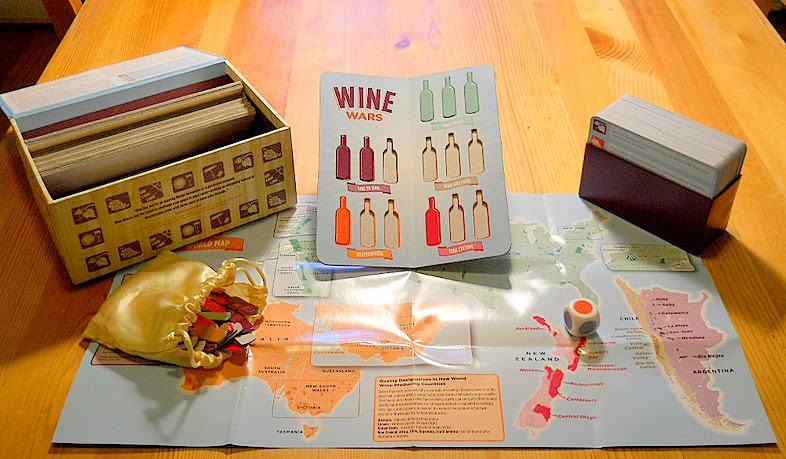
Both Foodie Fight and Wine Wars are trivia games, making them automatically awesome. Both games have a pretty simple set up - each player (or team, if you have more than six players) gets a small score card to keep track of how many points have been won per category. In Foodie Fight, the scoring chips are half moons that are put into place settings on a table card; in Wine Wars the scoring chips are wine bottles. The games also include a color-sided die, which determines which category of question gets asked.


From there on out the rules are simple. For the fast-track version of the games, the first person to get one chip per category wins. For the regular paced version, the first person to get all the chips in every category wins. If you’ve won a category but roll that color you must answer the question for no points before re-rolling the die. Each player continues on their turn until and incorrect answer is given. If you roll gray on the die, you are entitled to choose the category that you would like to answer.

Both games are packaged in sturdy boxes with magnetic lids with fun graphics. We leave our copies stacked on the bookcase - ready to play over dinner or a glass of wine. They’re fun and amusing, and we learn something new and interesting every time we play. So if you need a break from hunching over your minis with a tiny paintbrush and an arsenal of paint, play a trivia game with your spouse!

(As a man who rarely drinks wine, I actually like this game as well, though I rarely win since my knowledge of wine is rather limited. It's a quick, fun game.)